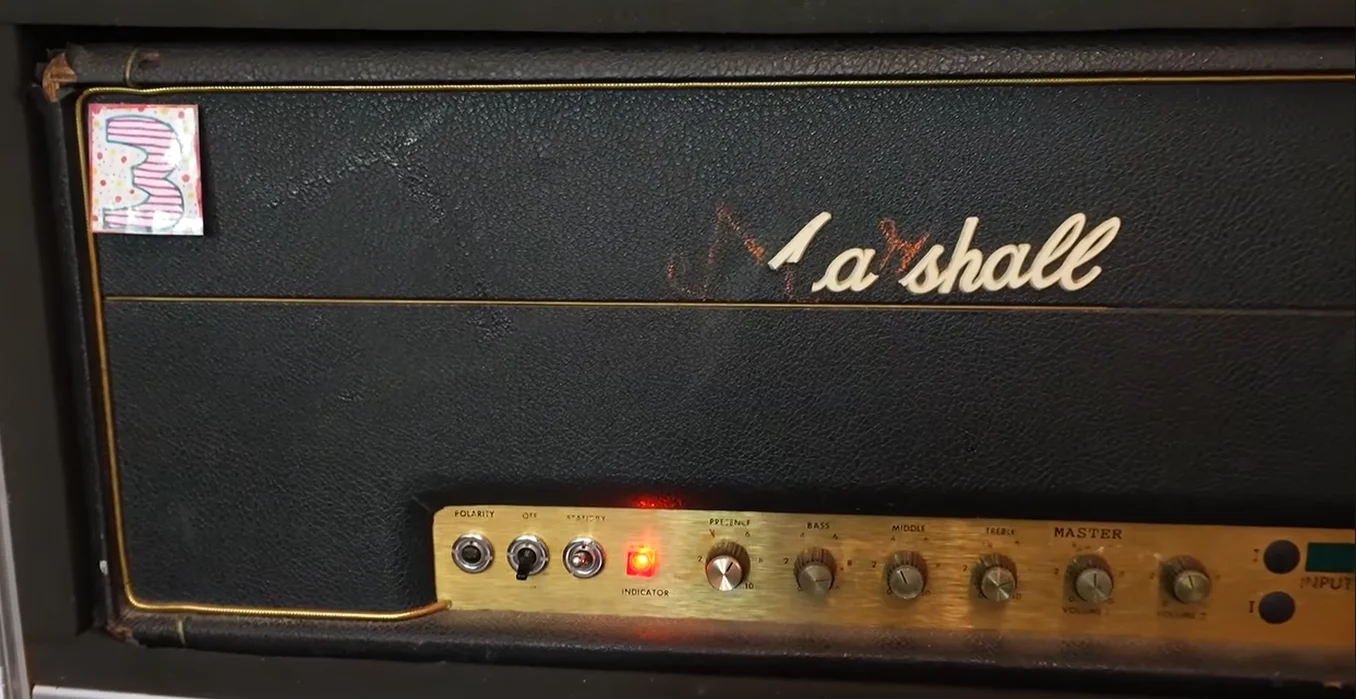
Longtime Green Day producer, Rob Cavallo, still owns the original Marshall used to create Billie Joe's guitar sound on Dookie, and we finally get a proper look at it in a new video with guitarist Tim Pierce.
Cavallo identifies the amp as a 1971 Marshall 1959SLP (Super Lead Plexi). Billie recorded the album with Blue, which had been fitted with a Seymour Duncan JB humbucker to replace the original pickup that had corroded, through the modified head and a Marshall 4x12 cabinet loaded with Vintage 30 speakers. That fairly simple setup became one of the most recognizable guitar sounds of the last 30 years.
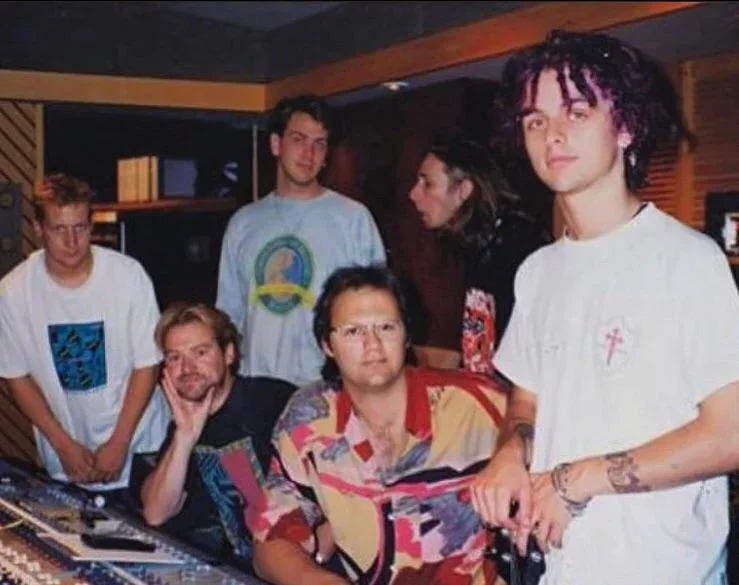
Green Day with Rob Cavallo and engineer Neill King during the recording of Dookie in 1993He worked with Bob Bradshaw from Custom Audio Electronics (CAE) to mod the amp.
"Nobody really had any money. But I decided to spend a little on the off chance that he might like the sound of it. I got a 71 plexi and we went to Bob and I said, "Make something that sounds kind of punk, but also sounds kind of rich" so that it would kind of straddle between something that was just very intense and bright, but also something that would be kind of musical and something that would sort of sing. So, Bob and I we just hung out together and he would try different modifications."
A stock Marshall model 1959 has two channels, each controlled by its own volume knob, but no master volume. On Rob's amp, "MASTER" has been added above the original Volume I control, showing that it had been converted to a master-volume arrangement. Marshall describes that copied circuit as cascading the amp's gain stages so the signal travels through both channels in sequence, rather than using them as separate channels. That creates more gain and sustain while retaining the clarity of the original sound. The original custom Marshall 1959SLP with the inputs capped and MASTER above Volume 1. The logo filled in with Crayon
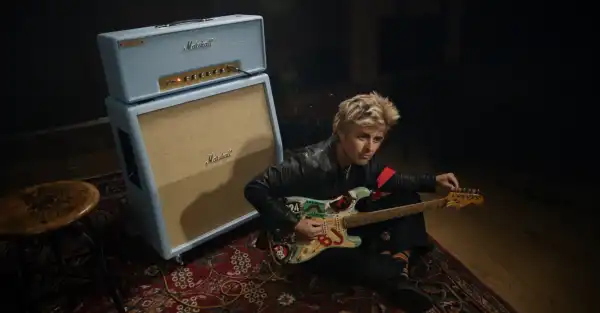
In practical terms, one control determines how hard the preamp is driven into distortion, while the master controls the overall output. Marshall R&D director Jon Magill explained that the same basic gain-and-master arrangement was carried into the new 1959BJA, along with filtering changes designed to make it sound bigger and livelier than a standard Marshall master-volume amp.
The video also clears up a detail that has become muddled over the years: Rob's original studio amp is not Pete (the iconic amp still used on tour). After recording Dookie, Billie bought his own Marshall 1959SLP and had Custom Audio Electronics modify it to recreate the sound of Cavallo's amp. That reproduction became Pete and went on the road with Green Day. Rob kept the original, and apparently continued using it on plenty of other records over the following three decades.
Pierce and Cavallo demo the original before comparing it directly with Marshall's new 1959BJA signature amp, with Rob saying that the new amp captures the sound perfectly.
"They really are the same amps. Just one's healthier. This one's healthier. But I guarantee you in 50 years this one will sound like that one. So, I'm really so happy for Billie Joe and Bill Schneider, who's Billie Joe's main guitar and amp tech, and then of course Marshall themselves for making this one available to everybody. They pulled it off. It's the real thing."
If you'd like to learn some more details about the other studio hardware used to record Dookie, check out this in-depth detailed interview from 2011 with engineer Neill King who recorded with Rob and Green Day at Fantasy Studios.



Comments
Story Comments